If you compare the dense, gravelly deposits near the Pitt River to the looser, silty sands along the Fraser's old floodplain, you start to understand why a single vibrocompaction recipe never works for Port Coquitlam. The city sits on a mix of glaciomarine and fluvial sediments, and the transition between a well-draining profile in the Mary Hill area and a more stratified deposit on the downtown side can happen within a single block. When we design a vibrocompaction program here, we never start with a standard grid; we start by mapping the depositional history, because the river has moved too many times over the past 10,000 years to assume uniformity. A CPT test run before any layout decision gives us the continuous stratigraphy needed to spot those thin silt seams that can kill compaction efficiency if nobody looks for them.
In the Fraser River corridor, vibrocompaction design is less about reaching a single density number and more about managing the natural variability of young fluvial deposits.
Service characteristics in Port Coquitlam
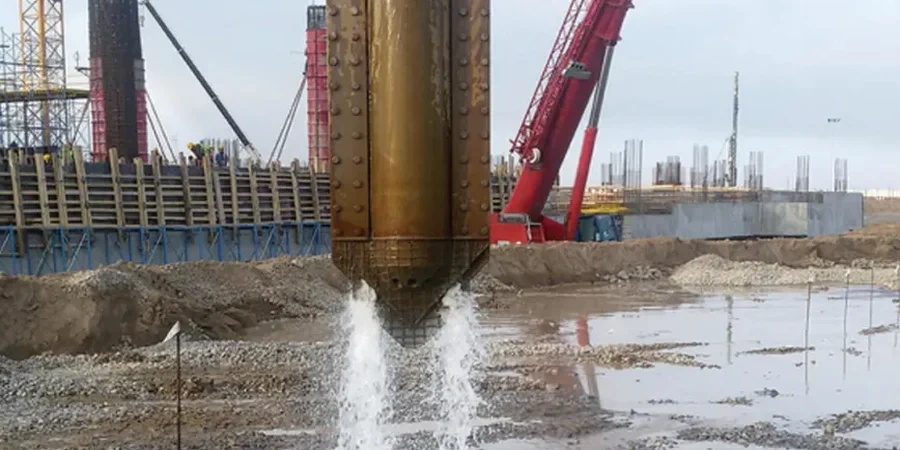
Local geotechnical conditions in Port Coquitlam
We were called to a warehouse site on Kingsway Avenue where the pre-design CPT showed a loose sand layer from 3.5 to 7.2 meters—right where the foundation slab and column footings would transfer load. The owner assumed the site was uniform because surface fill looked consistent. Had we skipped the CPT and applied a generic grid, the thin silt lenses we found at 5.8 meters would have reflected energy upward during compaction, leaving the sand below them dangerously loose. In a seismic event on the order of the Cascadia subduction scenario, that untreated band would be the first to trigger differential settlement under the slab. That scenario is not hypothetical in Port Coquitlam; the city sits on the edge of a liquefiable basin, and post-earthquake reconnaissance from Christchurch and Kobe shows exactly how partial compaction fails. Our design integrated a staged treatment sequence—pre-penetrate the silt seam, compact the lower zone, then treat the upper sand—verified by post-treatment CPT at every column location.
Our services
Every vibrocompaction design we produce for Port Coquitlam projects includes the field investigation, energy calibration, and verification testing needed to close the loop between prediction and performance. These three service components work together on every job:
Pre-Treatment Site Characterization
We run CPTu soundings, selective SPT borings, and grain-size analyses to build a three-dimensional model of the target sand unit, identifying silt seams, gravel lenses, and the water table position before any vibroflot mobilization.
Vibrocompaction Grid and Energy Design
Using the pre-treatment data, we specify vibroflot type, amperage draw, probe spacing in triangular or square layouts, lift thickness where staged treatment is needed, and dwell time per increment—all calibrated to the target relative density.
Post-Treatment Verification and Reporting
Within 48 hours of compaction, we execute a program of CPT soundings at column centroids and edge locations, comparing pre- and post-treatment tip resistance and friction ratio curves. The final report confirms whether the design density was achieved and documents any zones requiring re-treatment.
Quick answers
How much does vibrocompaction design cost for a typical Port Coquitlam site?
For a standalone vibrocompaction design package—including pre-treatment CPT investigation, grid and energy specification, and post-treatment verification reporting—costs in Port Coquitlam generally range from CA$1,790 to CA$6,090 depending on site area, depth of treatment, and number of verification soundings. A small commercial lot with straightforward sand conditions falls at the lower end; a larger industrial parcel with variable stratigraphy and a dense verification program runs higher.
What soil types in Port Coquitlam respond best to vibrocompaction?
Vibrocompaction works best in clean to slightly silty sands with less than 15 percent fines passing the No. 200 sieve. Much of Port Coquitlam's subsurface fits that description—the Fraser River and Pitt River deposits are predominantly granular. Where silt content exceeds 18–20 percent, we typically evaluate alternative methods like stone columns or rigid inclusions, because vibroflot energy dissipates too quickly in fine-grained matrices to achieve the specified density.
How long does the design and verification process take?
A typical schedule runs three to four weeks: one week for pre-treatment CPT and lab testing on grab samples, one week for grid design and energy specification, and one to two weeks for post-treatment verification after the contractor completes compaction. We coordinate the verification CPTs immediately after treatment so the contractor can move off site without waiting.
Does the NBCC require post-treatment verification testing?
Yes—the National Building Code of Canada requires documented verification that ground improvement has achieved the design intent, particularly where seismic densification is part of the foundation strategy. Our standard verification program uses CPT soundings at a minimum of one per treated column, with pre- and post-treatment tip resistance and friction ratio curves compared directly. The report becomes part of the permanent building record submitted to the City of Port Coquitlam.