In Port Coquitlam, we've seen how quickly ground conditions can change from one lot to the next. You might hit dense glacial till at 8 metres on one side of Pitt River Road, and then find soft, compressible silts just a block away. That's exactly why our field crew relies on the cone penetration test as a first-line investigation tool. The CPT gives us a continuous, real-time profile of soil behaviour without the disturbance that comes with drilling and sampling. Whether you're designing a low-rise commercial building along Lougheed Highway or planning a residential foundation near the Coquitlam River floodplain, the data we log from a CPT sounding helps pin down the stratigraphy that governs settlement and bearing capacity. We often pair it with lab index testing like grain size distribution to calibrate the soil behaviour type from the cone readings against actual samples from nearby boreholes.
A CPT profile through Port Coquitlam's post-glacial silts doesn't just show layers — it shows drainage paths, and missing those can double your excavation dewatering costs.
Service characteristics in Port Coquitlam
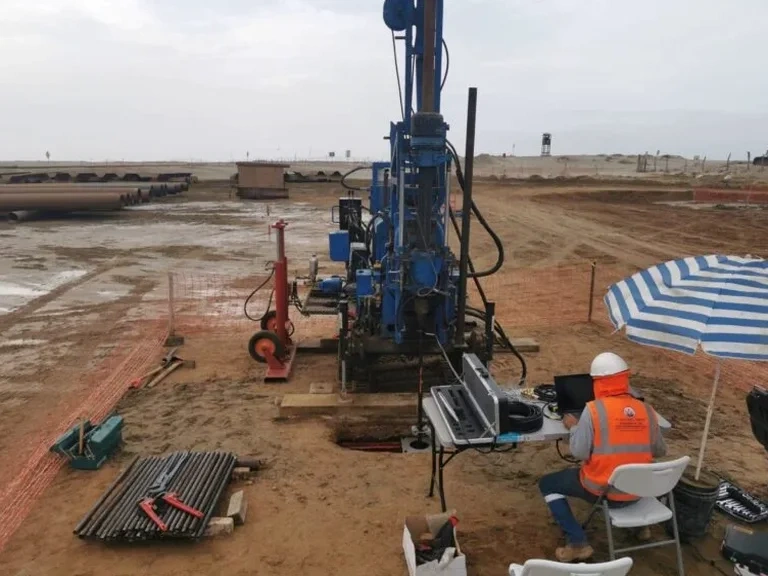
Local geotechnical conditions in Port Coquitlam
The single biggest mistake we see in Port Coquitlam is designing a foundation on CPT data that's been interpreted without accounting for excess pore pressure dissipation. In the low-permeability silts and clays that blanket much of the city — especially near the Pitt and Coquitlam River lowlands — the standard 2 cm/s push rate generates significant undrained loading. If you don't run at least one dissipation test to estimate the coefficient of consolidation, you're essentially designing for a soil state that won't exist once the structure is built. We've reviewed jobs where ignoring this led to bearing capacity overestimates of 30 percent or more. Another common risk: stopping the CPT at refusal on a thin gravel lense and assuming you've hit till, when in fact another 5 metres of soft material sits below. In seismic applications, misreading a borderline Site Class D profile as Class C under NBCC 2020 can trigger a fundamental redesign of the lateral system — an expensive, entirely avoidable outcome when the cone data is properly paired with shear-wave velocity measurements.
Our services
Every CPT project we run in Port Coquitlam includes more than just the raw cone data. Here's how we support your geotechnical program from mobilization to final report:
Piezocone (CPTu) profiling
Full u2 pore pressure measurement during penetration, essential for stratigraphic refinement and consolidation parameter estimation in silty soils.
Dissipation testing
Stopped-push tests at predetermined depths to measure pore pressure decay and derive in-situ coefficient of consolidation, critical for settlement time-rate predictions.
Soil behaviour type classification
Normalized SBT charts (Robertson 1990, 2016) applied to every sounding, cross-checked with local geological knowledge of the Fraser Lowland deposits.
Liquefaction screening reports
Integrated analysis using CPT tip resistance and sleeve friction data to evaluate liquefaction potential per NBCC 2020 and Boulanger & Idriss (2014) triggering procedures.
Quick answers
How much does a CPT sounding cost in Port Coquitlam?
For a typical single-day mobilization in Port Coquitlam with one or two CPT soundings to depths of 15–25 metres, the cost generally falls between CA$210 and CA$300 per metre of penetration, which covers the rig, operator, cone, data acquisition, and the engineer-reviewed log. Shallow pushes or projects requiring multiple dissipation tests may shift the final figure, and we always confirm scope before scheduling.
How deep can you push the CPT cone in Port Coquitlam soils?
It depends entirely on the subsurface conditions at your site. In the soft silts and clays common to the Pitt River corridor, we can often reach 25 to 30 metres before encountering refusal. Where dense Vashon till is shallower — for example, in the higher-elevation areas north of Lougheed Highway — refusal may occur at 10 to 15 metres. We always push to the maximum practical depth on the day.
Do I still need a borehole if I run a CPT?
In most cases, yes — the CPT and a borehole serve complementary roles. The CPT gives you near-continuous stratigraphy and in-situ parameters, but it doesn't recover a physical sample. A borehole with SPT or thin-wall sampling at a couple of locations lets you calibrate the CPT soil behaviour type with actual material, run lab tests like Atterberg limits and triaxial, and confirm groundwater conditions. We typically recommend at least one borehole per investigation.
What's the difference between a CPT and a CPTu?
A standard CPT measures cone tip resistance and sleeve friction. A CPTu — or piezocone — adds a pore pressure transducer at the cone shoulder (u2 position). That extra channel tells you whether the soil is draining during penetration, identifies thin silt seams that may not show up in the mechanical channels, and allows you to run dissipation tests to estimate consolidation properties. In Port Coquitlam's low-permeability silts, we almost always recommend running the CPTu.
How long does a CPT investigation take?
For a single sounding in typical Port Coquitlam ground conditions, the push itself can take anywhere from 45 minutes to two hours, depending on depth and the number of dissipation stops. With mobilization, setup, and breakdown, a one-day visit usually covers two to three soundings. We'll give you a realistic timeline once we've reviewed the site access and expected stratigraphy.