Port Coquitlam sits on the Fraser River floodplain, and much of the city is underlain by deep compressible silts and clays that extend 15 to 30 meters before reaching competent bearing strata. With a seismic hazard value of Sa(0.2)=0.95g under NBCC 2020, shallow footings often cannot meet settlement or overturning criteria here. We apply pile foundation design to transfer structural loads past the soft upper soils and into dense glacial till or bedrock, combining local borehole data with advanced geostructural modeling. For sites near the Pitt River where organic soils are common, we frequently recommend supplementing the investigation with a CPT test to map the continuous stratigraphy before sizing the pile group.
A pile that misses the till by half a meter can settle more than one that bears 5 meters deeper — the transition zone is that sharp in the Fraser River delta.
Service characteristics in Port Coquitlam
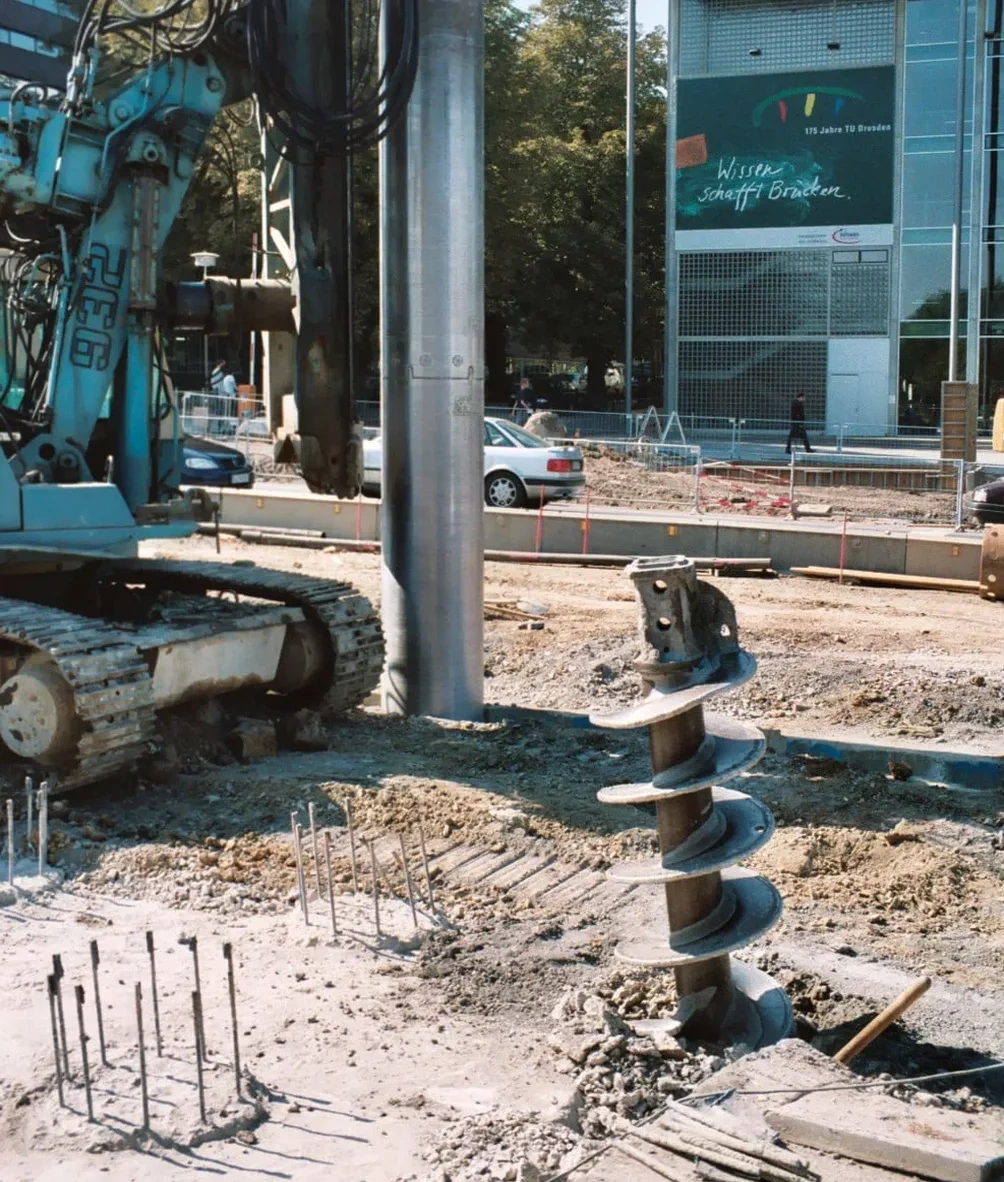
Local geotechnical conditions in Port Coquitlam
Port Coquitlam's population has grown past 61,000, and the push for multi-family residential and mixed-use buildings along the Lougheed Highway corridor is accelerating. That means deeper excavations adjacent to existing structures and higher column loads — exactly the conditions where a poorly designed pile foundation becomes a liability. The most common failure mode we investigate locally is not pile structural failure but excessive differential settlement, usually because the design assumed uniform bearing when the till surface actually undulates several meters across a single building footprint. Add a seismic event generating pore pressure in the interbedded sands, and a pile group that looked conservative on paper can lose significant skin friction. We run settlement analysis under both static and post-liquefaction conditions for every Port Coquitlam project, because the combination of soft soils and high seismicity leaves no margin for guesswork.
Our services
We adapt the pile foundation design to the specific subsoil conditions we encounter across Port Coquitlam, from the floodplain to the upland benches. Each option below addresses a different combination of depth to till, access constraints, and structural demand.
Driven Steel H-Piles
Fast installation through soft clay to refusal on dense till, with high driving resistance confirming capacity. We design for both compression and uplift on sites with high water table.
Cast-in-Place Concrete Piles
Suitable for sites where vibration from driving is a concern near existing structures. We specify casing details to prevent necking in the saturated silt layers common here.
Helical Pile Foundations
Effective for lighter structures and underpinning jobs where access is tight. Torque-to-capacity correlation is calibrated against local soil borings for reliable performance.
Liquefaction-Resistant Pile Design
We reduce skin friction and increase lateral reinforcement in zones with liquefiable sand lenses, following the NBCC 2020 provisions and Seed & Idriss methodology.
Quick answers
What do pile foundation design services cost in Port Coquitlam?
For a typical residential or light commercial project in Port Coquitlam, pile foundation design fees range from CA$2,390 to CA$8,910 depending on the number of piles, soil investigation requirements, and whether liquefaction analysis is needed. Complex multi-storey or industrial projects with specialized seismic detailing fall at the upper end of that range.
How deep do piles typically need to go in Port Coquitlam?
Most sites along the Fraser River floodplain require piles between 15 and 30 meters deep to reach competent glacial till. The exact depth varies block by block — a geotechnical investigation with boreholes or CPT soundings is essential to map the till surface before finalizing pile lengths.
Does NBCC 2020 require liquefaction analysis for pile design here?
Yes. Port Coquitlam's seismic hazard and soil profile — loose to compact sands interbedded with soft silts — trigger the liquefaction assessment requirements in NBCC 2020. We evaluate both the loss of skin friction and the potential for lateral spreading in the pile design, following the provisions of the code and accepted Canadian geotechnical practice.