The National Building Code of Canada references standard geotechnical investigations for any subdivision or infrastructure work, and in Port Coquitlam that almost always leads back to the California Bearing Ratio test. We run the soaked CBR according to ASTM D1883 because the native soils here, predominantly silts and clays deposited by the Fraser and Pitt Rivers, are notoriously moisture-sensitive. With an average annual precipitation of 1,500 mm hitting the Tri-Cities area, a subgrade that looks solid in August can lose over half its bearing capacity by December once the water table rises. That is why the flexible pavement design section in our reports ties the soaked CBR value directly to the structural number the City requires. Over twenty years of testing in the Mary Hill and Citadel areas, we have seen how a two-point difference in CBR can shift the required granular base thickness by a hundred millimeters.
A soaked CBR of 2 versus 4 on the same Port Coquitlam silty clay can mean the difference between 300 mm and 200 mm of crushed base course.
Service characteristics in Port Coquitlam
Local geotechnical conditions in Port Coquitlam
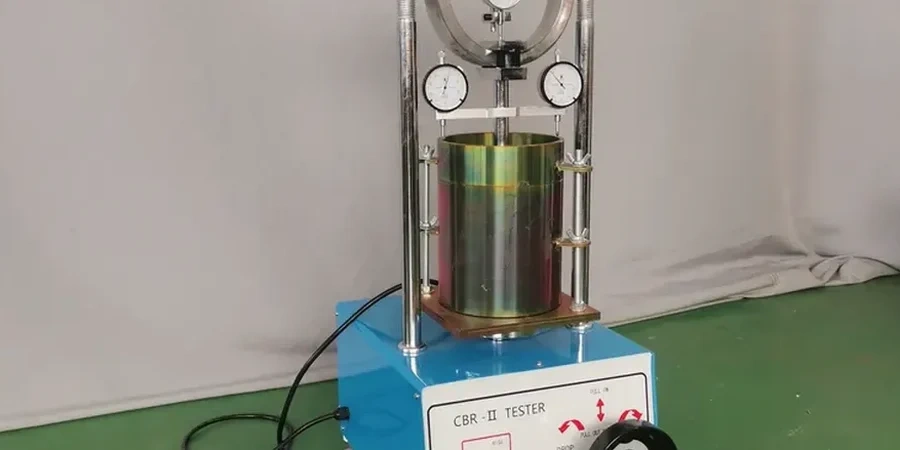
The equipment we mobilize for the laboratory CBR test centers on a motorized loading frame with a 50 kN capacity ring and a 49.6 mm diameter piston. The real risk in Port Coquitlam is not the equipment itself but the specimen preparation phase. The Fraser River floodplain clays have a narrow window of workable moisture content; if the technician allows the sample to dry even slightly before compaction, the density achieved in the lab will be artificially high, and the soaked CBR will over-predict field performance. We use controlled humidity chambers during mixing and compact within 30 minutes of moisture conditioning. The other failure mode we see from third-party labs is skipping the swell measurement during the 96-hour soak. In the low-lying areas north of Lougheed Highway, the silty soils can swell 4 to 6 percent when saturated, and that volumetric change alone can crack a rigid pavement if the rigid pavement design does not account for differential heave.
Our services
Our CBR program in Port Coquitlam goes beyond the standard remolded test. Depending on the project phase and the municipality reviewing the submission, the scope often expands into complementary analyses that strengthen the pavement design package.
Soaked CBR with Swell and Consolidation
We run the full four-day soaked CBR including dial-gauge swell monitoring and a one-dimensional consolidation test on the same soil. This gives the pavement engineer both the bearing ratio and the anticipated heave, which is critical for approaches to the Pitt River Bridge where the subgrade sits below the seasonal high-water table.
Field CBR Correlation Package
For larger subdivision projects, we combine the laboratory CBR with a field DCP campaign using a TRL dynamic cone. We develop a site-specific correlation equation so the earthworks contractor can verify compaction quality daily without waiting for lab results.
Quick answers
What CBR value does the City of Port Coquitlam require for residential streets?
The City of Port Coquitlam Engineering Design and Construction Specifications generally require a minimum soaked CBR of 5 percent at formation level for local residential roads. Collector roads and industrial access routes may be specified at 8 percent or higher. We recommend checking the current revision of the City's Subdivision and Development Servicing Bylaw, as the requirement can vary by neighborhood depending on the subgrade classification map.
How much does a laboratory CBR test cost in Port Coquitlam?
For a single-point soaked CBR test with moisture-density relationship, the cost ranges from CA$190 to CA$330 depending on whether swell and consolidation data are included and how many points are needed on the compaction curve. A full three-point CBR program with Atterberg limits and grain size runs toward the upper end of that range.
How long does it take to get CBR results back from the lab?
The soaked CBR test itself requires a 96-hour soaking period per ASTM D1883, so the minimum turnaround from sample receipt to draft report is five to six working days. If the project also needs a Standard Proctor to establish the compaction target, add one extra day. We always recommend coordinating sample drop-off at least two weeks before the pavement design submission deadline to allow for retesting if the first set of results is marginal.