The floodplain geography of Port Coquitlam, sitting at the confluence of the Pitt and Fraser Rivers, creates a subsurface profile that keeps geotechnical engineers on their toes. Silts and soft clays deposited by centuries of river meandering mean that bearing capacity isn’t a given—it has to be proven. The triaxial test becomes the definitive tool when you’re dealing with these saturated, compressible deposits. Unlike simpler index tests, this procedure replicates the confining pressures and drainage conditions a foundation will actually experience, giving you an honest look at the soil’s shear strength. And in a city where the water table sits just a couple of meters below the surface, understanding effective stress through a consolidated-undrained triaxial test isn’t academic theory; it’s the difference between a settlement calculation that holds up and one that leads to a call-back you don’t want. We often pair this with CPT testing to correlate the continuous cone resistance with lab-measured strength, building a ground model that makes sense of the river’s layered history.
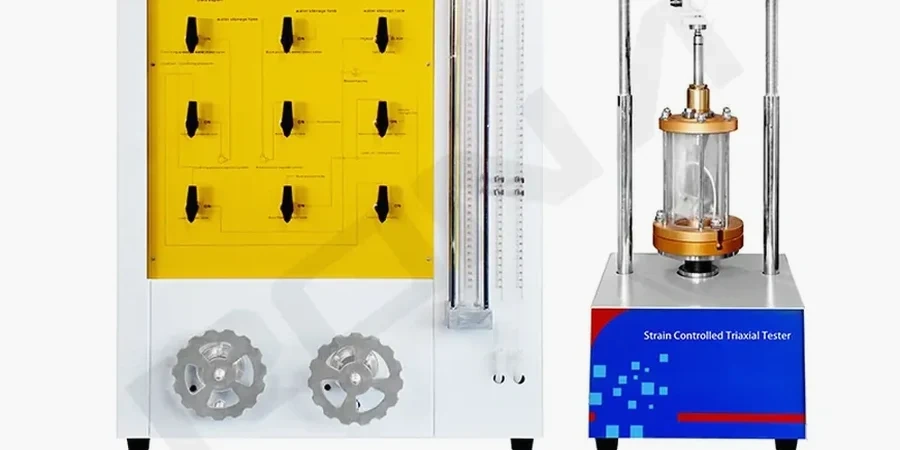
A triaxial test measures the two parameters that actually govern a soil’s resistance: cohesion and the effective friction angle, under the exact drainage conditions your project will impose.
Service characteristics in Port Coquitlam
Demonstration video
Local geotechnical conditions in Port Coquitlam
The BC Building Code 2018 and the Vancouver Geotechnical Society’s guidelines for Fraser River delta soils both underscore the need for site-specific strength testing when organic silts or sensitive clays are encountered. Port Coquitlam’s older neighborhoods, built on what was once bog and backwater, have lenses of low-plasticity silt that lose significant strength when remolded. The triaxial test is the only lab method that can quantify this sensitivity and give you a post-peak strength envelope. If your site investigation skips this step, you risk using peak strength values in a soil that will soften to residual strength under cyclic loading—a scenario that becomes critical given the seismic hazard from the Cascadia subduction zone. Liquefaction triggering analyses from SPT or CPT data need to be calibrated against cyclic triaxial results to be defensible, and that’s where an integrated approach using SPT drilling data alongside lab testing pays off.
Our services
Our triaxial testing program in Port Coquitlam is built around the specific soils of the Lower Mainland. We don’t run a generic lab schedule; we tailor the confining stress range and drainage conditions to your project’s depth and groundwater conditions. Here’s what that looks like in practice:
Consolidated-Undrained (CU) Triaxial with Pore Pressure
The standard for Port Coquitlam’s saturated silts and clays. We saturate specimens under back-pressure, consolidate to in-situ stress, and shear undrained while recording pore pressure. Provides effective stress strength parameters (c', φ') for drained stability analysis and undrained shear strength (Su) for short-term bearing capacity.
Consolidated-Drained (CD) Triaxial
For granular soils and long-term drained conditions under mat foundations or embankments. Slower than CU but gives the true effective friction angle without pore pressure correction, critical for coarse Fraser River sands encountered in deep excavations.
Cyclic Triaxial Testing for Liquefaction
Replicates earthquake loading by applying cyclic deviator stress under undrained conditions. We measure the number of cycles to liquefaction at various cyclic stress ratios, providing data that calibrates your SPT- or CPT-based liquefaction assessment for Port Coquitlam’s seismic design category.
Multi-Stage Triaxial Testing
When borehole recovery is limited and you can’t get three identical specimens, we run multiple consolidation and shear stages on a single sample. Economical for preliminary design phases while still generating a Mohr-Coulomb failure envelope.
Quick answers
What does a triaxial test cost for a project in Port Coquitlam?
A standard consolidated-undrained triaxial test on a single specimen typically runs between CA$2,620 and CA$3,790, depending on the number of confining stress stages and whether you need cyclic loading or drained conditions. A full suite of three CU tests to define the Mohr-Coulomb envelope will be at the higher end of that range. We provide firm pricing once we review the Shelby tube logs and know the soil type, because highly sensitive clays require careful specimen trimming that adds lab time.
How long does a triaxial test take from sample delivery to report?
Plan on 5 to 7 business days for a standard CU triaxial suite of three specimens. The consolidation phase alone takes 24 hours per specimen for Port Coquitlam’s silty clays, and shearing at the slow strain rate required by ASTM D4767 adds another 4 to 6 hours per specimen. Cyclic triaxial testing extends the timeline by a few days because of the post-cyclic reconsolidation and monotonic shear stages. We can expedite if the lab schedule allows, but saturation and consolidation can’t be rushed without compromising the B-parameter check.
What's the difference between a triaxial test and an unconfined compression test?
An unconfined compression test runs on a cohesive soil with zero lateral pressure, which means it can’t account for the confinement the ground actually provides. You get an undrained shear strength that’s often conservative for saturated clays and completely invalid for anything with silt or sand. The triaxial test applies controlled confining pressure, allows you to measure pore pressure during shear, and separates the friction angle from cohesion. If you’re designing a foundation in Port Coquitlam’s floodplain deposits, the triaxial test gives you parameters you can actually use in a finite element or limit equilibrium model.