A warehouse expansion near the Coquitlam River hit refusal at 1.2 meters. The silt and peat went down another six. Traditional piling was cost-prohibitive for the 15,000 sq ft slab. The geotechnical report called for a vibro replacement solution. That is where our stone column design work begins. Port Coquitlam has extensive pockets of compressible alluvium deposited by the Fraser and Coquitlam Rivers. These soils consolidate unevenly under load. A properly engineered stone column grid transfers stress to the dense glacial till below. It densifies the surrounding matrix during installation. We model the composite ground to limit total and differential settlement to under 25 mm for standard slabs. The design integrates site-specific CPT data, which we often correlate with a CPT test performed on the same pad before mobilization.
A stone column grid cuts consolidation time from years to weeks in Port Coquitlam's river silts.
Service characteristics in Port Coquitlam
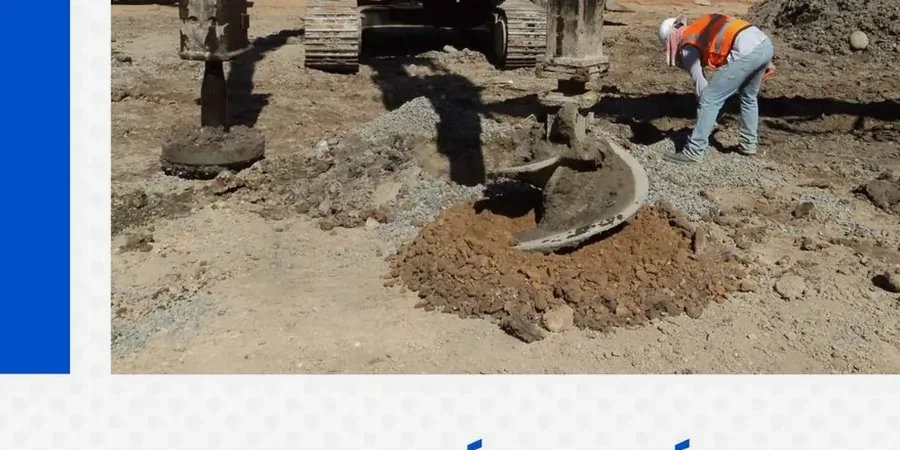
Local geotechnical conditions in Port Coquitlam
We see contractors order stone columns without a site-specific design. They assume a generic grid. Then the floor slab cracks because the stiffness contrast between the treated and untreated zones was never modeled. In Port Coquitlam, the transition from soft alluvium to dense till can be abrupt. A column that terminates 0.3 meters too high loses its end bearing. The load concentrates at the tip and punches into the weak layer. Another failure mode: using standard gravel with too many fines. It clogs the column and blocks drainage. The column becomes a rigid inclusion instead of a draining stone element. Pore water pressure builds. The design must specify a clean, single-sized stone and a full depth to competent bearing. Field verification with modulus load tests on sacrificial columns confirms the design assumptions before production drilling.
Our services
The stone column design is packaged with the investigation and verification phases. All three deliverables form a closed loop for the ground improvement contract.
Composite Ground Modeling
We develop a numerical model of the stone column grid using axisymmetric unit cell analysis. The output is a settlement curve under the design load and a stiffness profile for the structural engineer.
Installation Specification
We prepare the method statement for the vibro contractor. It defines the vibrator type, stone gradation, column depth, spacing, and the sequence to avoid lateral displacement of adjacent columns.
Post-Installation Verification
We specify and execute the QA/QC plan: SPT or CPT soundings between columns, plate load tests on individual columns, and topographic monitoring of the platform during surcharge.
Quick answers
What is the typical cost range for stone column design in Port Coquitlam?
The design package, including site investigation review, numerical modeling, and installation specification, ranges from CA$1,710 to CA$6,730. The spread depends on the treatment area and the number of verification tests required.
How deep can stone columns go in Port Coquitlam soils?
We typically design columns to terminate in the dense glacial till or coarse Fraser River sands. In the downtown and Mary Hill areas, this means depths of 8 to 15 meters. The vibrator must penetrate the full soft layer and key into the bearing stratum by at least 0.5 meters.
Can stone columns be used under footings or just slabs?
They work for both. Under isolated footings, we design a densified group of columns directly beneath the footing footprint. The composite modulus is checked against the column load. For strip footings, a rectangular grid is aligned with the wall axis.
What stone gradation is specified for the backfill?
We specify a clean, hard, angular stone, typically 20 to 75 mm in size, with less than 5% passing the 5 mm sieve. This gradation ensures high permeability and prevents clogging. The stone source is documented in the material submittal before delivery to the Port Coquitlam site.