The BC Building Code 2018 references CSA A23.3 and geotechnical site investigation requirements that make seismic tomography a logical choice in Port Coquitlam. Much of the city sits on deep glaciomarine and alluvial deposits from the Coquitlam and Pitt Rivers, with bedrock depths varying significantly across neighborhoods. Standard drilling tells you what happens at one point. Seismic tomography fills the gaps between boreholes, mapping velocity contrasts that correspond to changes in soil stiffness and rock quality. SPT drilling gives you a point measurement, but the tomographic line ties those points together. We run the survey along proposed building footprints, pipeline corridors, and road alignments where knowing the continuous bedrock profile matters for excavation planning and foundation depth decisions.
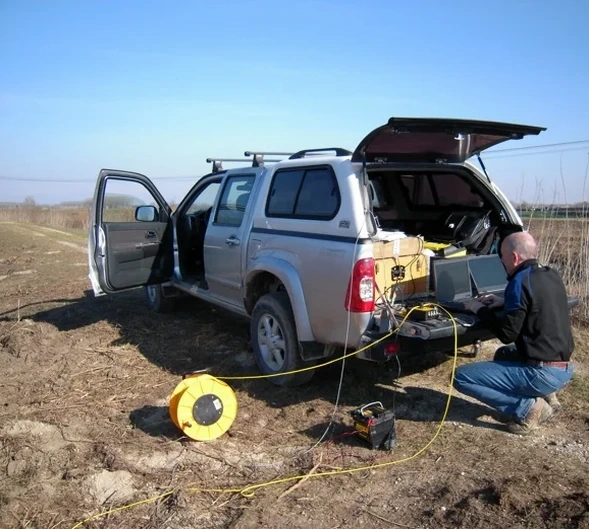
A velocity cross-section from seismic tomography connects the dots between boreholes, showing exactly where competent bedrock rises or drops along a building footprint.
Service characteristics in Port Coquitlam
Demonstration video
Local geotechnical conditions in Port Coquitlam
At just 5 meters above sea level near the Coquitlam River, Port Coquitlam faces a moderate seismic hazard amplified by its soft soil conditions. The 1946 Vancouver Island earthquake (M 7.3) produced noticeable shaking here, and a Cascadia subduction event would generate long-period ground motion that deep sediments can amplify. NBCC site class D and E soils are common, especially in the low-lying areas south of Lougheed Highway. Seismic tomography identifies velocity reversals—where softer material underlies stiffer crust—that can trap seismic energy and increase shaking duration. Without this imaging, a site classified by a single borehole might miss a low-velocity layer 20 meters down. The shear-wave velocity profile from tomography feeds directly into site-specific response analysis, giving the structural engineer a better basis for the seismic design category than a default table value. It matters for schools, municipal buildings, and any post-disaster structure under Part 4 of the BC Building Code.
Our services
Our approach in Port Coquitlam integrates seismic tomography with complementary geotechnical methods to build a complete ground model for each project. We do not treat geophysics as a standalone product but as one layer of the investigation.
2D Seismic Refraction Tomography
We run linear arrays across your site with hammer or weight-drop sources, processing first-arrival times into a P-wave velocity model. Ideal for mapping bedrock depth, rippability, and lateral changes in overburden stiffness along pipeline routes and building footprints.
Combined Refraction and MASW
We acquire both P-wave and surface-wave data in the same field layout. The refraction line gives the geological structure and the MASW inversion delivers the shear-wave velocity profile required for NBCC site classification. One mobilization, two datasets.
Seismic Reflection for Deep Targets
When bedrock lies beyond 40-50 meters, we switch to a reflection acquisition geometry with a longer spread and a higher-energy source. This images stratigraphic boundaries in the unconsolidated sediments filling the Coquitlam basin.
Quick answers
What does a seismic tomography survey cost in Port Coquitlam?
For a single refraction line with standard 24-channel equipment, the cost typically ranges from CA$4,120 to CA$6,120 depending on line length, access conditions, and whether we combine it with MASW for shear-wave velocity profiling. Longer lines, multiple spreads, or reflection processing add to the scope. We provide a fixed-price quote after reviewing your site plan and project objectives.
How does seismic tomography differ from MASW in Port Coquitlam soils?
Tomography images P-wave velocity in a 2D cross-section, which responds strongly to water saturation and rock competence. MASW maps shear-wave velocity, which governs dynamic soil stiffness and site class. In Port Coquitlam's saturated alluvial soils, P-wave velocity alone can be misleading because saturated sand and soft clay both show values around 1,500 m/s. We recommend running both methods together to separate lithology from saturation effects.
What depth can you reach with seismic tomography in the Lower Mainland?
With a standard 72-meter spread and a sledgehammer source, we typically image to 15-20 meters. Using a weight drop or accelerated weight drop source and extending the spread to 120-150 meters, we reach 30-50 meters. For deeper bedrock mapping in the Coquitlam basin, we use seismic reflection geometry, which can image beyond 80 meters. The actual penetration depends on the velocity structure and ambient noise at your site.