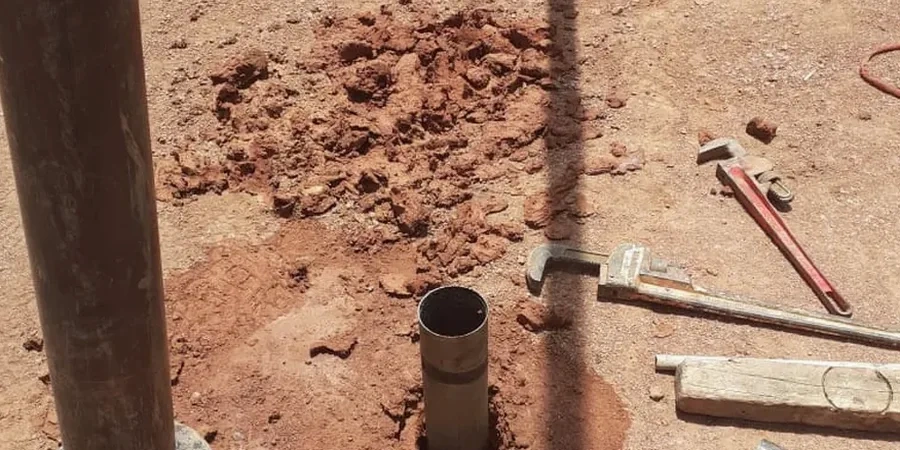
The packer assembly is lowered carefully into the NQ borehole, sealing off the test interval before water is injected under controlled pressure. In Port Coquitlam, where the Pitt and Coquitlam Rivers have deposited complex sequences of glacial till, sand, and silt, this kind of direct measurement becomes indispensable. A single Lugeon test run in fractured bedrock beneath the Mary Hill Bypass tells us more about real seepage paths than a dozen lab permeability tests on disturbed samples. We deploy both the constant-head Lefranc method for soil and the multi-stage Lugeon test for rock, adapting the pressure steps to the expected hydrogeological regime. Because the city sits at the confluence of major waterways, with a water table that responds rapidly to seasonal freshet, standard assumptions about hydraulic conductivity can be dangerously off. Our team runs these tests on sites ranging from Port Coquitlam's light industrial lots to the steeper terrain near the Coast Meridian overpass, always correlating field data with the CPT test logs when soft alluvium is present.
A five-stage Lugeon test doesn't just give you a permeability value — it reveals how the rock mass behaves under hydraulic load, which is what really matters for grouting design.
Service characteristics in Port Coquitlam
Local geotechnical conditions in Port Coquitlam
In Port Coquitlam, we often encounter perched water tables in the upper silty layer that mislead contractors into thinking the site is dry, while the underlying sand and gravel unit carries significant artesian pressure. Running a Lefranc test only in the shallow zone would miss this completely. The consequence of underestimating hydraulic conductivity here is not just a wet excavation; it can destabilize adjacent footings on the compressible organic silts found in pockets across the floodplain. For rock tunnels or deep infrastructure near the Canadian Pacific Railway corridor, an inaccurate Lugeon value leads to underspecified grouting programs, and that means water inflows that delay the project by weeks. We have seen cases where re-grouting costs exceeded the original contract value because the initial permeability assessment relied on lab tests instead of in-situ packer testing. The Lugeon test also gives us the critical P-Q curve shape, which directly informs whether the fractures need high-mobility or high-viscosity grout.
Our services
Our field permeability services in Port Coquitlam cover the full range of in-situ hydraulic testing, from simple soil assessments to complex rock mass characterization. Each program is designed around the specific stratigraphy and project requirements.
Lugeon packer testing for rock
Multi-stage pressure testing in fractured bedrock for tunnel alignment studies, dam foundations, and deep basement excavations. We run standard five-stage sequences and interpret P-Q curves to guide grouting design.
Lefranc permeability testing for soils
Constant-head tests in granular and cohesive soils to determine hydraulic conductivity for dewatering design, infiltration basins, and contamination plume modeling.
Quick answers
What is the difference between a Lefranc test and a Lugeon test?
The Lefranc test measures hydraulic conductivity in soil by injecting water at constant head into an isolated borehole section. It is used primarily in unconsolidated materials. The Lugeon test is designed for fractured rock; it applies water under pressure in five stages (increasing then decreasing), and the resulting flow-pressure curve reveals fracture behavior. A Lugeon value of 1 is roughly equivalent to 1 x 10⁻⁷ m/s hydraulic conductivity.
When does the City of Port Coquitlam require in-situ permeability testing?
For stormwater infiltration systems, the City typically requires field permeability testing per the Subdivision and Development Servicing Bylaw. Deep excavations near existing structures, shoring designs, and any project requiring a groundwater control plan will also need in-situ hydraulic conductivity data. We coordinate with the engineering department to ensure the test program meets their submission requirements.
How long does a field permeability test take in Port Coquitlam?
A single Lefranc test at one depth typically takes 30 to 60 minutes once the borehole is prepared. A full five-stage Lugeon test in rock runs 60 to 90 minutes per interval. For a typical Port Coquitlam site with three to four test intervals, we can complete the field work in one day, assuming the drill rig has advanced the borehole to target depth.
What does field permeability testing cost in the Tri-Cities area?
For Port Coquitlam and the surrounding Tri-Cities, field permeability testing typically ranges from CA$960 to CA$1,380 per test interval, depending on depth, access conditions, and whether a drilling crew is already on site. A complete program with multiple intervals and a technical report is priced accordingly. We provide a detailed quote after reviewing the geotechnical investigation plan.
Can you run a Lugeon test in an existing monitoring well?
No. Lugeon tests require an open borehole in rock so the packer can seal against the borehole wall at the desired depth. A monitoring well with a screened casing and sand pack cannot be used. We drill a dedicated NQ borehole specifically for the test. Lefranc tests can sometimes be performed during advancing the borehole before casing is installed.