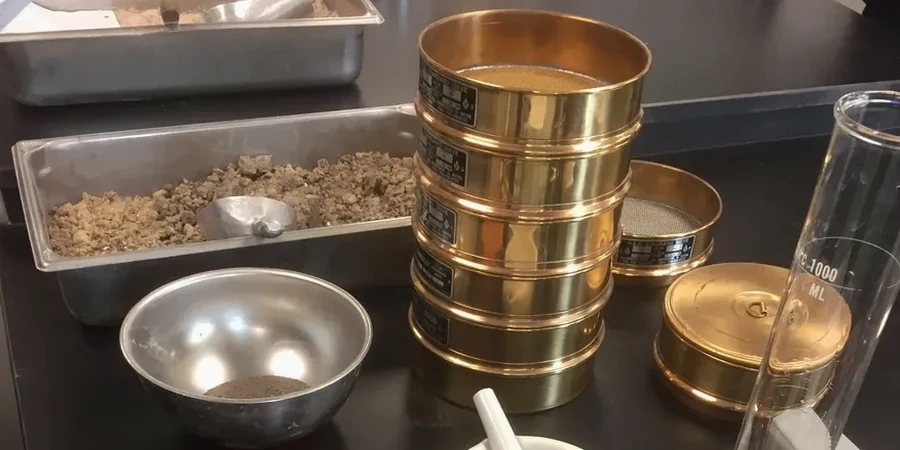
The stack of brass sieves sits on the mechanical shaker in our lab, each pan capturing a progressively finer fraction of the soil sample delivered from a Port Coquitlam job site. For the coarse portion, we run the material through a series of ASTM E11 sieves from 75 mm down to the No. 200, weighing the retained mass on each. The fine fraction that passes through is then dispersed in a sodium hexametaphosphate solution and analyzed with a 152H hydrometer, tracking suspension density over a 24-hour period to derive the silt and clay distribution. This dual approach is what the National Building Code of Canada expects when soil strata contain both granular and cohesive components, a scenario we encounter routinely in the Tri-Cities area where glacial till and Fraser River floodplain deposits intermingle. The resulting particle size distribution curve becomes the foundation for soil classification under the Unified Soil Classification System, informing everything from footings design to compaction specifications.
A grain size curve that misses the silt fraction can overestimate permeability by ten times, turning a straightforward excavation into a dewatering problem.
Service characteristics in Port Coquitlam
Local geotechnical conditions in Port Coquitlam
The BC Building Code, referencing the NBCC, requires soil classification based on particle size distribution for seismic site classification in accordance with Table 4.1.8.4.A. In Port Coquitlam, where much of the urban area sits on deep Fraser River sediments with a shallow water table, misclassification of a Site Class D versus Site Class E profile carries serious structural design consequences. A silty fine sand that plots just across the fines content threshold can shift the site period and amplify spectral accelerations in ways the structural engineer did not anticipate. Liquefaction susceptibility assessment under NBCC 2020 also depends directly on the grain size curve, particularly the coefficient of uniformity and fines content, parameters that come exclusively from a combined sieve and hydrometer test. When we see old geotechnical reports that only ran a wash sieve without the full hydrometer, we recommend re-testing rather than relying on incomplete data for a foundation that must perform through a Cascadia subduction event.
Our services
Our grain size testing program covers the full spectrum of particle size analysis required for geotechnical design and construction quality control in Port Coquitlam.
Combined Sieve and Hydrometer Analysis
Full particle size distribution from gravel to clay fraction, reported with D-values, uniformity and curvature coefficients, and USCS classification per ASTM D2487. Essential for seismic site classification and liquefaction screening on Port Coquitlam sites underlain by Fraser River sediments.
Wash Sieve and Fines Content Determination
Focused analysis for construction quality control where the primary concern is verifying that imported fill meets the specified gradation envelope and maximum fines content. We run this frequently for road base and structural backfill projects in the Port Coquitlam industrial and commercial zones.
Quick answers
How much sample material is needed for a combined sieve and hydrometer test?
We typically require a minimum of 500 grams of dry soil for a combined analysis, though for gravelly soils with particles larger than 19 mm, a larger mass of approximately 2 to 5 kg is necessary to ensure the coarse fraction is statistically representative. The sample should be sealed in an airtight bag immediately after collection from the Port Coquitlam site to preserve the natural moisture content.
What is the typical cost for grain size analysis in Port Coquitlam?
For a standard combined sieve and hydrometer analysis, the cost ranges from CA$160 to CA$270 depending on the number of sieve sizes specified, whether the hydrometer test includes the full sedimentation curve or a single-point determination, and the reporting format required by the design engineer.
How does the hydrometer test work and why is it necessary when we already have the sieve results?
The hydrometer test measures the density of a soil-water suspension over time as particles settle according to Stokes' Law. Larger silt particles settle faster, while clay particles remain suspended for hours. Since the No. 200 sieve only tells us the total mass passing 0.075 mm without distinguishing silt from clay, the hydrometer is the only standard method to quantify the clay fraction, which controls plasticity, shrink-swell potential, and long-term consolidation behavior in the fine-grained units common across Port Coquitlam.