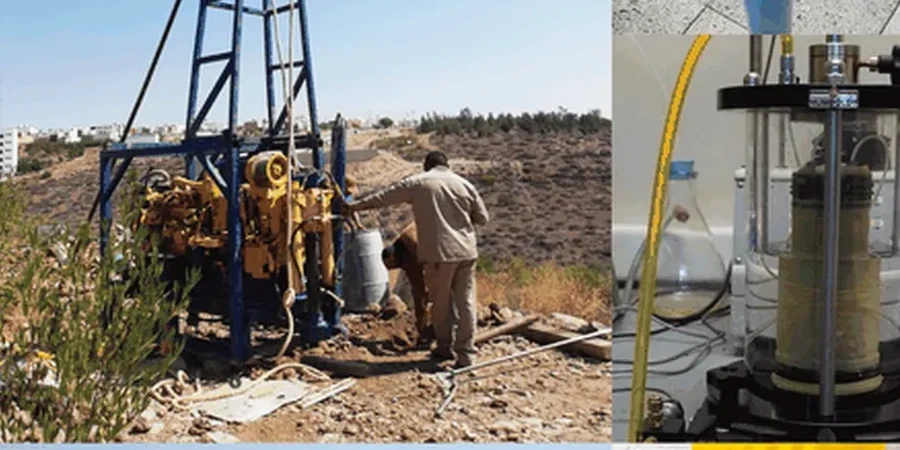
Section 4.2 of the NBCC 2020 and CSA A23.3 set the baseline for foundation design across Canada, but what really drives a soil mechanics study in Port Coquitlam is the local geology. You’re dealing with thick glaciomarine silts and sands over till along the Pitt River flats, plus pockets of organic clay that can compress six times more than a clean sand under the same load. We run every project through a full lab program—triaxial shear, one-dimensional consolidation, Atterberg limits—so the bearing capacity number on the report isn’t just a textbook value, it’s tied to the exact unit you’re building on. For deeper profiles, we often pair the lab data with a CPT test to map continuous stratigraphy without missing thin soft seams that a split-spoon sample can skip.
A bearing capacity number without a consolidation curve is half a report. In Port Coquitlam silts, secondary compression can double total settlement over 30 years.
Service characteristics in Port Coquitlam
Local geotechnical conditions in Port Coquitlam
The contrast between the Citadel Heights area and the lowlands near the Traboulay PoCo Trail is instructive. Up on the slopes, you get compact till with an OCR above 3—great bearing, low settlement, and the main risk is cut slope stability during excavation. Down along the Pitt River, the same structural load on normally consolidated silts can punch through a crust and mobilize settlement an order of magnitude larger. The real hazard in the lowlands is not bearing failure; it is differential settlement across a single building footprint. A soil mechanics study quantifies that differential movement so the structural engineer can stiffen the foundation or specify a mat foundation with enough rigidity to bridge the soft spots. Seismic site class also shifts—from Class C on the till to Class E or F on the deep organic deposits—directly affecting the design spectral acceleration.
Our services
Our soil mechanics study in Port Coquitlam is structured as a modular package—you can commission the full investigation or pull individual components depending on your project phase and the geotechnical complexity flagged during the desktop review.
Full geotechnical laboratory program
Triaxial (CU and CD), direct shear, consolidation (oedometer), Atterberg limits, grain size analysis by sieve and hydrometer, and moisture-density relationship (Proctor). All tests run to ASTM standards with chain-of-custody documentation.
Bearing capacity and settlement analysis
Ultimate and allowable bearing capacity calculated using the general shear failure equation with Terzaghi-Meyerhof factors, plus immediate, primary, and secondary settlement components plotted against log time for each foundation alternative.
Seismic site classification and liquefaction screening
Site class determination per NBCC Table 4.1.8.4.A using shear wave velocity or N60 data. Liquefaction potential evaluated with the Seed-Idriss simplified procedure, including post-liquefaction settlement estimates where the factor of safety falls below 1.1.
Quick answers
What does a soil mechanics study in Port Coquitlam typically include?
It covers site-specific drilling and sampling, laboratory testing for strength and compressibility, groundwater monitoring, bearing capacity and settlement calculations, and a seismic site classification per NBCC 2020. The report also includes foundation recommendations, excavation safety notes, and any required liquefaction screening.
How much does a soil mechanics study cost for a single-family home in Port Coquitlam?
For a typical single-family lot in Port Coquitlam, a soil mechanics study runs between CA$4,830 and CA$7,060 depending on the number of boreholes, depth, and lab tests required. Sites with known organic soils or deeper exploration needs fall toward the upper end.
How deep do you drill for a soil mechanics investigation here?
Minimum depth is 3 m below the proposed foundation level, but we often go deeper—6 to 10 m—in the Pitt River lowlands to capture the full compressible layer thickness. If deep fill or organic clay is encountered, depth extends until competent till or dense sand is confirmed.
Do I need a soil mechanics study for a renovation or addition?
Yes, if the addition increases the foundation load or changes the structural system. Even for a single-storey addition, the City of Port Coquitlam may require a geotechnical letter confirming the existing foundation is adequate or recommending underpinning if the soils beneath show signs of past settlement.
How long does it take to get the final geotechnical report?
Fieldwork takes 1–2 days. Laboratory testing runs 2–3 weeks, depending on consolidation and triaxial test duration. The final report is typically delivered 3–4 weeks after drilling, with a preliminary bearing capacity letter available within 5 business days if you need something for permit submission.